Wednesday, 2 October 2013

An adventurous journey home

My blogging has become a bit lapse recently as I have had the lovely Bebhinn staying at my house. Bebhinn is also a TMA with VSO and she has just started her placement in Rwamagana. I agreed to let her shadow me for a few days so she could see what the role entails.

Yesterday, Bebhinn and I visited one of my further-away schools. Unfortunately the head teacher informed us when we arrived that we could only stay for the morning as he had some business to attend to in the afternoon. We were not too upset by this and quickly made arrangements with our moto drivers to collect us at midday with the intention of being dropped in to town so we could do a spot of shopping, walk home and then get on with some admin tasks. Alas, it was not to be.....

Our motos arrived at midday ready to take us home but the Head Teacher then decided that we could not leave without taking lunch so our motos were asked to wait whilst we were presented with this:

After a delicious feast, we prepared to board our motos but the drivers had disappeared. Eventually we found Safari sleeping in an empty classroom. He told me it was about to rain so we should wait in the school for the storm to pass, and within minutes, the rain was bucketing down! The noise of it hitting the classroom roof was incredible - there is no way lessons can continue during that sort of downpour. Unfortunately the rain continued for another hour and we were not able to leave the school until 2pm. But then we were on our merry way.........

Until.....my moto broke down. I think rain water got inside the mechanism somehow which caused it to go "chug chug chug" and then die. (Technical terms, of course!). Bebhinn and I had quite the crowd of onlookers including a number of children who should have been in the school where we had been working. After 10 minutes of waiting, we decided to start walking home. We had a lovely walk for an hour or so, after which the motos, freshly mended, caught up with us, and whisked us home.

It was really nice to enjoy the landscape at a walking pace and we took lots of photos on our adventure. Here are a few of my favourites which demonstrate the variety of houses in my district.


As you can see Ngoma has lots of banana plantations. In the distance, you can just see one of the beautiful lakes, which lots of the teachers I work with enjoy visiting with picnics during the holiday.

ALOA Schools

Last week was incredibly busy as Moses and I collected data from four of the schools in our ALOA sectors.

The collection went relatively smoothly and it was certainly an interesting exercise. During the week, we assessed 60 children and I found it interesting to see how different their responses were to English children. For example, when asked reading comprehension questions, most of the children who did not know the answer would reply with a word from the excerpt, clearly trying to second-guess an answer, in contrast to children in the UK who would probably remain silent or say "I don't know". It also entertained me when many of the children answered the question "What hit Senga on the head?" with the answer "sister" instead of the correct answer, "rain". I am fairly sure they gave this answer because the story talks about Senga's family, not because they think sisters normally hit their siblings over the head!?!  I also discovered that most of the children could read nonsense words just as well as real words. I suppose they were sounding them all out and probably didn't comprehend the meaning of many of the real words, so this, sadly, would explain the lack of significant difference here.

On Wednesday, we visited the school which is in our comparative sector, a place where we do not provide any support but still collect data so that we can compare it to the data in the sectors where our intervention takes place. I found it hard to be at this school because the teachers and children were really eager to see, and work with, us and I had to confess that we would only visit again when it came to collecting more data. It then took us 4 hours to get home from this school, which is supposed to be an hour and a half on moto. But 10 minutes into the journey, the rain came down in torrents and we had to seek shelter next to a building. Thankfully, a door quickly opened and we were beckoned into a shop where we were able to dry out, buy tea and seat for an hour and a half until the rain stopped and we could continue our journey. I never knew rain could be so painful!

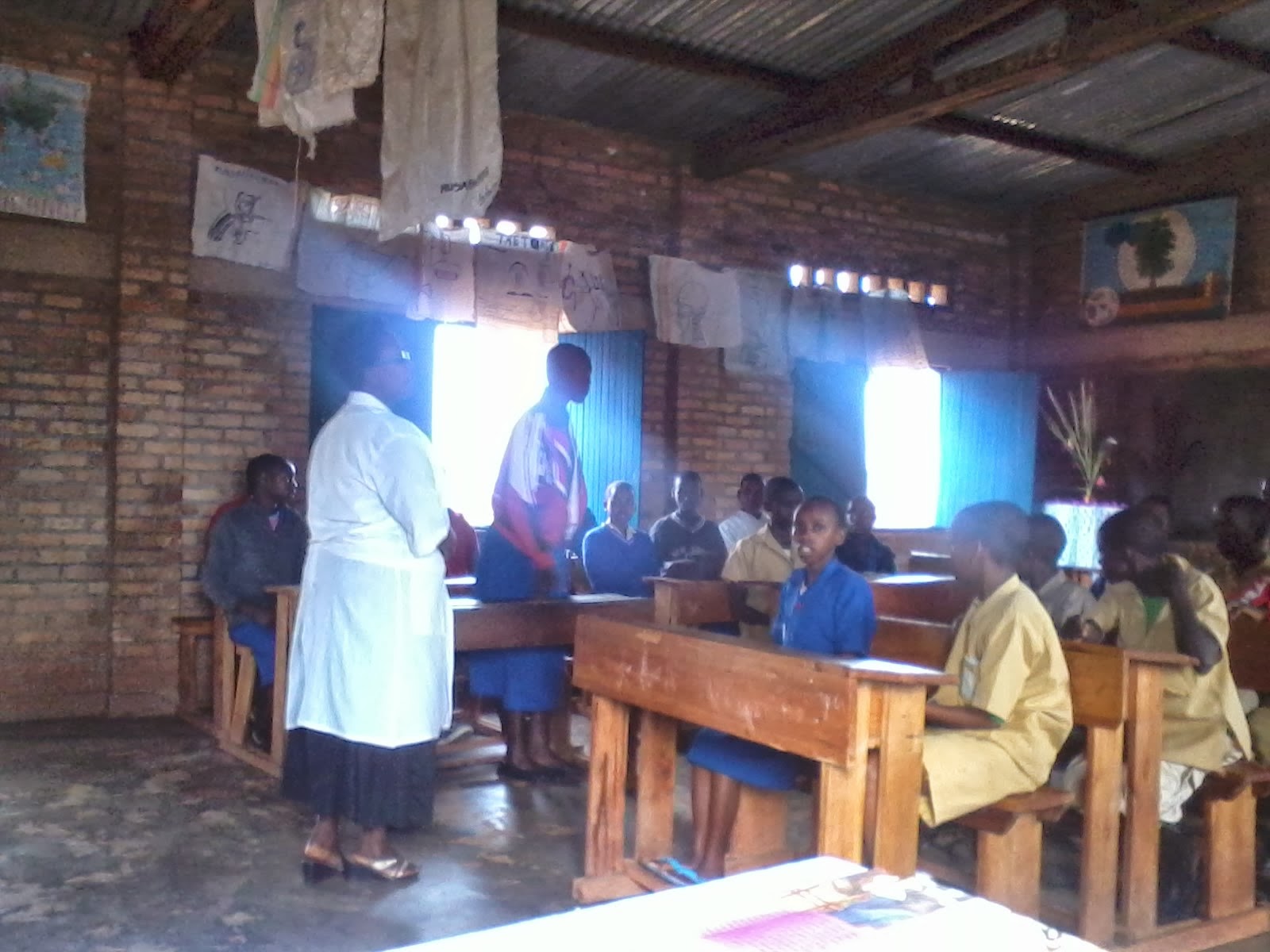
I took a few photos at the schools during the week, and here you can see the contrast between a classroom where we provide intervention, and one that doesn't get support from VSO:


Wednesday, 18 September 2013

Part II in Rwanda begins

After a wonderful break in England, which consisted mainly of eating chicken and prawns, drinking diet coke, enjoying long hot showers. catching up with family and friends and planning Amanda's wedding, I am now safely back at my home in Rwanda. Here is a photo from the lovely Mr and Mrs Capps' wedding in Sunny England:


It is now the rainy season in Rwanda and within the past 24 hours I have already experienced two massive downpours, with thunder and lightning. Of course, we are lucky because in between the downpours, the sun returns which doesn't often happen in England. But the climate definitely feels different to how it was 3 weeks ago and I'm not looking forward to experiencing a downpour mid-moto ride!

I was very happy to find that my tomatoes had ripened whilst I was away. Patrick has, very kindly, been picking them for me and this is what I found in my kitchen: 
 
I was quite pleased with myself to have grown these from seed (look back through my blog for the photo of tomatoes growing in my garden).

This afternoon, having been to the market, I set about making bolognese using my new mincer, which my aunt kindly bought for me: 
 
The mincer works a treat and has drastically enhanced my menu options...Now I am dreaming of hamburgers, shepherds pie and fajitas which are all within my reach- feeling like quite the domestic goddess!

As for work, the next couple of weeks will be very busy as we begin data collection for the Monitoring and Evaluation part of our VSO work. I will endeavour to blog again soon as I am sure the findings will be interesting and will hopefully demonstrate the impact we have been having at a local level.

Thursday, 29 August 2013

Uganda with Jess

After a whirlwind tour of Uganda which involved excessive hours spent travelling by road (more than 24 in one week!), I am now typing this on my flight back to England.

During the week, I found myself constantly comparing the country to Rwanda and I was surprised by how much I preferred Rwanda and missed my African "home". Kampala is a hectic city, with an enormous volume of traffic resulting in a minimum of 5 hours' rush hour every day. Despite the size of it, it seemed the centre was not well-designed and all the main travel hubs are in close quarters resulting in gridlock which even the boda bodas (motortaxis) could not avoid. Unlike Rwanda, safe driving does not reach the same level in Uganda. It is rare to see a Boda boda driver with a helmet on, let alone one for a passenger (which all Rwandan moto drivers carry). Our taxi driver told me that there is an entire wing in the local hospital full of people who have boda boda accidents and I can't say I'm surprised. Our first taxi journey demonstrated this as they were driving up the pavements, tearing in between cars, travelling with 3 passengers etc etc.

Generally Kampala is a colourful city, similar to Rwanda, with  different coloured buildings advertising various products. A big difference I noticed is the number of tiny shack-shops and food stalls out on the road (something Rwanda has stopped in recent years, instead finding roofed areas for craft markets etc to set up). The people seemed friendly even though we were overcharged by our first cab driver who insisted he had agreed 20,000 shillings each instead of a total ride for 20,000 shillings. We were careful not to fall into that trap again and double checked everything from then on.

Source of the Nile
Having briefly seen Kampala, we headed out to Jinja and the River Nile. The place we stayed in (Adrift) was spectacular. It had a picture-perfect log cabin bar, which overlooked the Nile and even had HOT showers! Whilst there, we visited the source of the Nile, where Lake Victoria meets the river but most excitingly, we went went white water rafting down the Nile; exhilarating, scorching hot and totally incredible. I will remember the sensation of floating down the Nile next to our raft very fondly, holding hands with Jess as she floated alongside me saying "Just taking a quick dip in the Nile" - magical!


Front right = me, behind me = Jess
Whilst in Jinja, we also did a bit more souvenir shopping. Jesso commissioned a painting because the one she liked was too big for her house boat. So the painter, Mike, set about making a smaller version for her whilst we continued walking for a couple of hours. Here he is in his studio, amidst his beautifully bright artwork. The big painting on the floor is the original we liked. Prices were a bit cheaper than Rwanda on the whole, although their African fabrics tended to be more expensive (so no more dresses for me!).

Next on the Ugandan hit list was Murchison Falls which brought about a safari, boat trip and visit to the waterfalls. I think photos will sum this up better than words. Unfortunately the lions decided not to come out to play but other than that, we had a high success rate on the animal spotting. Highlights included staying in safari tents whilst a hippo grazed  a couple of metres away from us and a naughty warthog ripped through our neighbours' tent because the even naughtier neighbours forgot to leave their biscuits at the bar (the strict "no food in the tents" rule is there for a reason).

To minimise the disappointment of not seeing the lions, Jess and I spent our last night in Uganda at the Entebbe Wildlife Centre and after a stunning sunrise, we went to visit the lions, hyenas, zebras (zeblas as they say in Rwanda) and cerval cats amongst other animals. The Education Centre is a great place to stay and for the cost of the dorm room (20,000 shillings per person) you get entry to the centre which is normally 30,000 shillings on its own.


A wonderful adventure to finish off Jess' stay in Africa. I will be sad to return to Rwanda without her although we have some amazing memories and photos of our time together. And fingers crossed she's got the bug and will come again soon ;-)

Sunday, 11 August 2013

Felicite's Wedding

Yesterday, Jess and I went to my friend Felicite's wedding. We were very excited as it was our first Rwandan wedding. Thankfully another friend and head teacher, Leandre, was there to act as interpreter for us which was really helpful as I'd been told that the first ceremony, the dowry giving, was very funny...but only if you understood Kinyarwanda.

During this ceremony, the man's family arrive and request that their boy is allowed to marry the girl of the hosting family. A dramatic debate follows where the girl's family put up lots of reasons why the boy cannot marry her (these are fictitious but present a humorous display for all the guests). Yesterday's reasons included "You came here before and wanted to marry another girl, she is still waiting for you" (the other girl was an elderly woman who stood up and waved at him!) and "our family member was stood by the roadside and you did not stop to give them assistance". Both times the boy's family responded well, much to the enjoyment of the wedding guests and eventually the girl was invited out of the house and presented to the groom. The groom's family gave a dowry of many gifts including money (to represent cows), alcohol, food and baskets to the bride's family and everyone celebrated.

After the 2 hour dowry-giving, where we were given food, drink and plenty of inhore dancing, we bundled back into our mini-buses and headed for the church. A Catholic service followed, which was very similar to the church weddings we have in England. Then we walked to a beautiful area near the church where the bride and groom served each other drinks, presents were given by the guests, more traditional dancing took place and we all shared some of the sponge cake.


It was a wonderful day and a great opportunity to get a snap-shot into the traditions of Rwandan marriage

Wednesday, 7 August 2013

Guest Blog by the maths geeks

Yesterday we took part in holiday training and ran a session for secondary maths teachers. Amy had warned us that the school was rural and the roads dusty, but we weren't quite prepared! After we left Kibungo, we were on our motos for about 45 minutes, all on dirt tracks - the views were spectacular and we passed through many small villages and banana groves. As I got off my moto at the school, Amy had total hysterics; I had left my visor up and my face was covered in a browny red dust. The rest of the dust was beaten off us by our moto drivers, but my face still has an orange hue!
 

9 maths teachers, a technology teacher and a biology teacher gave up a day of their holiday to spend with us. Having planned the day before, we hoped we had chosen the correct topics and methods to share with them, we chose topics we felt were important and had checked were on their curricula. We delivered learning through discovery, teaching kinaesthetically and the use of plenaries. The highlights included: hearing the teachers say they liked a technique and would use it in their classroom, their willingness to particiate even when we spoke too fast and it was difficult to understand, followed by the light bulb moment when they did understand and singing the circle song about 100 times.

 
 The teachers particularly liked doing graph aerobics, so much so that they kept giving us really silly graphs to represent (for the mathematicians amongst you try using your arms and legs to create y = 1/x).

Their positive attitude was evident in the feedback we received, all of them talking about learners enjoying techniques and their intention to share what they had done today with other teachers at their schools.

Whilst Rwandan schools often have 60 students in a class and much of the teaching is very traditional, it was great to see how quickly they caught onto new ideas. We were particularly impressed that they were able to identify techniques that are good for identifying the progress the students had made and where they need more help (AFL). 

We enjoyed the day so much that I am hoping to run the session again for teachers from a different area later in the week.

Sunday, 4 August 2013

Guest blog by Karen

It's amazing the people you meet and the opportunities that arise when you engage in conversation on your travels. Met a group from Team schools and IUE university who are  volunteering to teach as part of the Global village initiative, so I invited myself along for the morning.  Little did I know at the end I would be a guest speaker and have to critique the lessons I saw.

At 9am ten students from IUE and two students from Team high school New Jersey began teaching three classes of around forty children on a rota basis. Lessons were 55 minutes each, one on writing, one reading and one vocab taught  kinaesthetically all based around a story written by one of last year's students. This year's theme was the elephant and the fly which the Rwandan students will perform as a play on the last day of school.

The Rwandan students have to pay a small amount for the classes to show commitment, something none of them are short of...imagine a class of 40 English students working solidly for three hours in their summer holiday - I had difficulty when I thought of some of my students. I digress....in the kinaesthetic class the students played charades and Simon says based on verbs some of them knew and verbs from the story. This was to ensure they understood the meaning of the words. In the writing class they were using a grid to start to plan their own stories, characters/setting/problem/solution, some of the older students in English, some in a mixture of kinyarwanda and  English. They then shared and one of the Rwandan teacher volunteers translated if  needed. The reading group had the students repeating the story, acting out key words before writing them into the books and pens donated from fundraised money back in America.

All of the lessons had an interactive element and the smiles from the students indicated they were enjoying their learning. The most powerful scene was the Rwandan teachers joining in with enthusiasm and learning new techniques. The whole process repeated in the afternoon with a new cohort of students most of whom arrived an hour early. It is not often you can spend a day where every individual is learning all at the same time and so obviously enjoying themselves.